
Blog
AI Compliance in Pharma: Regulatory Risks, Monitoring Frameworks, and Governance Models
Prevent risky AI outputs before they ship. Set up continuous compliance monitoring with guardrails, audit trails, and real-time exception handling.


Share the article
When pharmaceutical manufacturers rely on three, four, or five different patient support program (PSP) vendors, each running its own platform, critical data gets trapped in silos. This results in multiple platforms, multiple schemas, and a single source of truth that doesn’t exist.
We build PSPs. We’ve seen what fragmented systems do to outcomes and operations. When every vendor lives in its own silo, you get blind spots in patient journeys, duplicated work, audit risk, and KPIs no one can trust. We call that avoidable friction.
A unified data layer is a centralized integration architecture that consolidates patient, service, and outcome data from all PSP vendors into a single, governed environment. It doesn't replace your vendors; it connects them through standardized APIs, master data management, and a common data model so your team sees one complete picture of every patient's journey.
The fragmentation problem is massive. Despite pharmaceutical companies investing over $5 billion annually in PSPs, only 3% of potentially eligible patients enroll. Data silos contribute directly to this failure: 72% of hospitals report patient data gaps that fragment care journeys, and specialty pharmacy staff struggle because there's no reporting standard between hubs, pharmacies, and manufacturers.
Fragmentation surfaces as four real business problems:
Most PSPs operate across four critical pillars, and fragmentation breaks each one:
Discovery often happens in one vendor’s system while enrollment sits in another. HCPs cannot see if a patient is already engaged, which leads to duplicate outreach, poor experience, and wasted spend. Fragmented data is one of the biggest blockers to accurate patient identification.
Enrollment requires insurance details, prior authorization forms, financial assessments, and consent. When these sit across multiple vendors and channels, teams end up doing manual reconciliation. This slows onboarding, increases compliance risk, and is a major reason only a fraction of eligible patients enroll in PSPs.
Specialty pharma dispensing, cold-chain logistics, nurse visits, and device training must be coordinated as one workflow. With fragmented platforms, no one sees the full handoff. Medication arrives but no nurse is scheduled, or insurance approval is complete but dispatch hasn’t started. These gaps extend time-to-treatment and hurt outcomes.
Refill support, adherence tracking, call-center follow-ups, adverse event reporting, and PV forwarding all require a unified view. Without it safety signals get mixed, adherence definitions vary by vendor, and you cannot prove program performance to payers or regulators.
The compliance risk is acute. Every pillar generates sensitive patient data. When consent and audit trails live across five different systems, audits become slow and risky. A unified PSP data layer gives manufacturers a single, governed source of truth that is audit-ready and defensible.
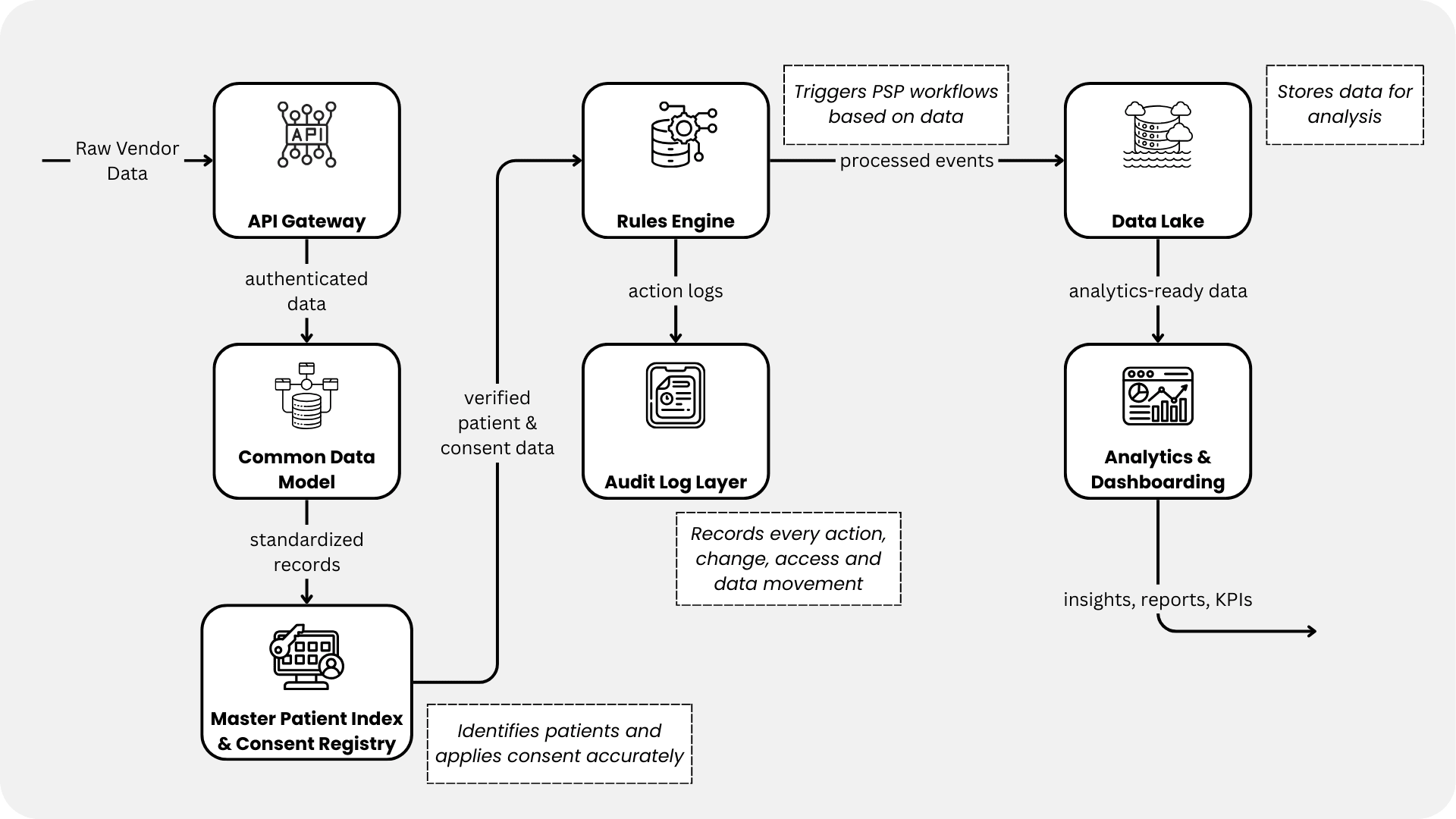
Most enterprise PSP platforms force you to adapt your workflows to their system design. Rigid SaaS was built for a “best practice” interpretation that doesn’t match your regional compliance rules, internal approval hierarchies, or vendor integrations.
Zelthy’s approach is fundamentally different. As a configurable, open-framework platform built for life sciences, Zelthy adapts to your workflows rather than forcing you to adopt new ones. It digitizes end-to-end PSP processes by aligning with existing SOPs, approval hierarchies, and compliance protocols, ensuring faster adoption, less change management, and a system that feels natural to operational teams.
The distinction matters operationally. When your compliance team needs to add a new regional approval step, they configure it in Zelthy; they don’t wait for a vendor release cycle. When you onboard a new specialty pharmacy vendor with a different data format, Zelthy’s open framework accommodates it without core platform changes. When your program expands to a new therapy or market, the configurable modules apply immediately.
Start with a phased approach that delivers value quickly while managing risk:
Pick the vendor that touches the most patients (specialty pharmacy or hub). Build mappings for enrollment, case status, and adherence events. Validate identity matching and consent enforcement end-to-end. This pilot proves feasibility and surfaces integration challenges before scaling.
Integrate nurse field services, reimbursement hubs, and financial assistance providers. Prioritize vendors that handle the most patient volume or compliance-sensitive data. Implement Master Patient Index to resolve duplicate identities across systems.
Formalize data stewardship roles, audit protocols, and vendor contracts. Ensure consent traceability meets HIPAA minimum necessary standards and GDPR data minimization requirements. Build dashboards for OIG compliance monitoring.
Connect digital PSP tools (apps, telehealth, patient portals) and activate advanced analytics. Deploy predictive models for adherence intervention and real-world evidence collection workflows.
1. Vendor Resistance: Some vendors resist API integration, fearing margin pressure.
Mitigation: Frame integration as mutual benefit—you get data, they get faster case resolution and renewal contracts. Include API development costs in vendor agreements.
2. Duplicate Patient Identities: Different vendors use different identifiers (email vs. phone vs. patient ID).
Mitigation: Implement probabilistic matching algorithms and manual review workflows in your Master Patient Index.
3. Data Latency: Real-time APIs sound great until you discover a vendor's system updates once daily.
Mitigation: Set SLAs in contracts (e.g., case status updates within 4 hours) and build monitoring alerts for delayed data.
4. Consent Mismatches: A patient consents to specialty pharmacy data sharing but not nurse services.
Mitigation: Granular consent management with purpose-specific flags and automated enforcement in your rules engine.
5. KPI Alignment: Vendors define "adherence" differently.
Mitigation: Document standard definitions in your common data model and require vendors to map their calculations to your definitions.
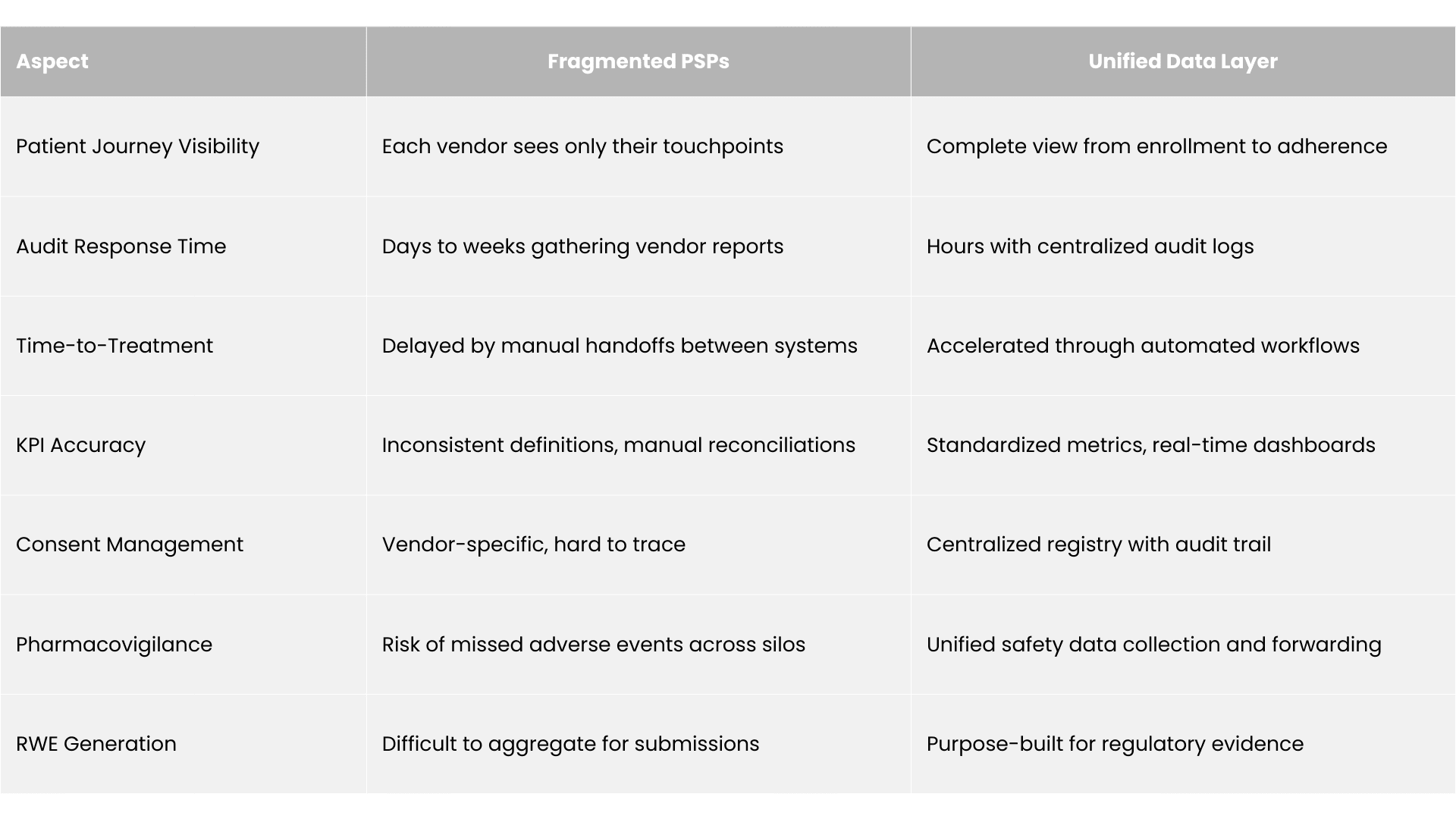
Reduced Time-to-Treatment: Integrated specialty pharmacy and hub models accelerate prior authorization from weeks to days through uninterrupted data flow and automated compliance checks. A patient moves from “diagnosis flagged” to “treatment started” without manual handoffs.
Higher Patient Adherence: PSPs with unified data show 29.3% higher adherence (64.8% vs 50.1%) and 4.8% months longer median persistence compared to fragmented approaches. When nurses, pharmacies, and call centers see the same patient data and coordinate proactively, adherence improves.
Lower Healthcare Utilization: Unified PSPs reduce emergency department visits by 28% and inpatient admissions by 17% over 36 months. Better adherence and coordinated monitoring catch problems early.
Operational Efficiency: Elimination of manual reconciliations, duplicate data entry, and inter-vendor phone calls cuts operational costs by 20-40%.
Faster Audit Response: When OIG or EMA requests pharmacovigilance data or compliance evidence, a unified system generates reports in hours rather than weeks spent coordinating with five vendors.
Accurate Payer Value Demonstrations: Unified KPIs enable credible real-world evidence submissions to payers, accelerating coverage negotiations and reimbursement decisions.
Zelthy was designed to bring every PSP vendor, workflow, and data stream into one governed ecosystem without forcing teams to rebuild their operations. The platform meets all the requirements of a unified PSP data layer while staying flexible enough to match each organization's real processes.
If you want, we can review your current PSP setup and outline what a unified layer would look like. This includes mapping vendor data, defining the consent and identity approach, and identifying where the real ROI will come from. It is often the simplest way to move from abstract conversations about fragmentation to a clear, workable plan that everyone can align behind.
Want to explore how Zelthy can transform your PSP operations? Contact us at connect@zelthy.com or send us a DM on LinkedIn for more information.
Dive into our comprehensive collection of blogs covering diverse topics in project management and beyond.
Reach out to us for inquiries, support, or partnership opportunities. We're here to assist you!
Use our convenient contact form to reach out with questions, feedback, or collaboration inquiries.


